I'm singing in the Toronto Opera Repertoire chorus again this year. We're putting on Offenbach's TALES OF HOFFMANN and Rossini's THE BARBER OF SEVILLE. (There are several really small male soloist roles in HOFFMANN, more acting than singing, and I might be cast in one!)
We usually do one opera with a big role for the chorus and one where their presence is smaller, and HOFFMANN definitely has the bigger chorus part of the two. So we've been concentrating on that one so far; we'll only be starting BARBER next week. I'm actually a bit behind so far this year: I was in London during the first rehearsal, and had to leave the second early because I was still dealing with jet lag. (I'd flown home the day before.)
Tonight we had an acting class for choristers, which is always fun. David Roche and Tita Griffin preside. (Giovanni Menardi, who'd just had a hip operation, came in on crutches to give us a class on pronouncing Italian and French.) They talked about the HOFFMANN plot, and we ended up splitting into sub-groups and making conversation as characters in a scene from the opera.
I was looking up the story behind HOFFMANN on Wikipedia, and it's pretty interesting. He was an actual romantic writer living in Germany early in the nineteenth century, and he wrote himself into his stories as the main character. (He also wrote the stories that the ballets NUTCRACKER and COPPELIA were based on, and some early science fiction.) I've seen it performed, both in the 1950 British movie directed by Powell & Pressburger and in the recent Met production that was broadcast in cinemas. Offenbach died before its premiere and there are several different versions, but the muse was really smiling on him during his last work!
Wednesday, October 17, 2012


Tuesday, October 16, 2012
Goodenough College
I spent eight months at Goodenough College in 1995. That's a residence for international graduate students located around Mecklenburgh Square in the Bloomsbury neighborhood of London, where I was researching my Ph.D. thesis on the British community in the Chinese treaty port of Chongqing. (I was fortunate that my sister Margaret had stayed there the year before: her connection helped me get in.) I did most of my London research at the Public Records Office in Kew (consular reports), though I also did some at places like the University of London's School of Oriental and African Studies.
They have two main residences: William Goodenough House (where I stayed, which is nicknamed Willy G.), and London House. It occurred to me that London House was like Chongqing's foreign merchant community, being mostly single people, while Willy G., with many married couples and families, was more like the foreign missionary community. They also have a hotel-style Goodenough Club, where I stay whenever I visit London.
When I revealed to my friend John George that I have a Ph.D., he was really impressed and said I should make more of it. But it really doesn't mean so much to me. When it was over I felt like the scene in EASY RIDER where Dennis Hopper says "We did it!" but Peter Fonda says "We blew it." The thesis wasn't as good as I wanted it to be--I was too defensive--and I was lucky to pass.
But the eight months I spent at Willy G. were the best eight months of my life! Besides my research work, I had time to get to know a great city full of history and culture, and even take part in several Willy G. activities--I helped run the video club--and get to know people. I remember a moment when I was strolling through the University of London campus on a Sunday afternoon in the fall, and really felt at home. (Or maybe it's a composite of moments in my memory.)
They have two main residences: William Goodenough House (where I stayed, which is nicknamed Willy G.), and London House. It occurred to me that London House was like Chongqing's foreign merchant community, being mostly single people, while Willy G., with many married couples and families, was more like the foreign missionary community. They also have a hotel-style Goodenough Club, where I stay whenever I visit London.
When I revealed to my friend John George that I have a Ph.D., he was really impressed and said I should make more of it. But it really doesn't mean so much to me. When it was over I felt like the scene in EASY RIDER where Dennis Hopper says "We did it!" but Peter Fonda says "We blew it." The thesis wasn't as good as I wanted it to be--I was too defensive--and I was lucky to pass.
But the eight months I spent at Willy G. were the best eight months of my life! Besides my research work, I had time to get to know a great city full of history and culture, and even take part in several Willy G. activities--I helped run the video club--and get to know people. I remember a moment when I was strolling through the University of London campus on a Sunday afternoon in the fall, and really felt at home. (Or maybe it's a composite of moments in my memory.)
Monday, October 15, 2012
Gold records
Youtube is a great channel for listening to music. I have a coffee-table book titled THE BOOK OF GOLDEN DISCS, listing records year by year that sold a million copies or more up to about 1977. Lately I've been going through the book backward from the last pages, listening to gold-record singles I don't recognize from the mid-'70s. (Some stuff I did recognize, of course. I was happy to listen to Chicago's "If You Leave Me Now" again.)
A lot of this music was mediocre, of course, but there were quite a few "keepers," like Sweet's "Little Willy" and the Elton John-Neil Sedaka duet "Bad Blood." There was also stuff like Raydio's "Jack and Jill," which I remembered hearing before without knowing anything about it. I also re-discovered Parliament's early rap album CLONES OF DR. FUNKENSTEIN, which I'd heard at a campus radio station. (One Youtube contributor managed to upload the whole album in a single post!)
And then there's the ear-worms, as the Germans call them. Stuff that gets into your head and won't leave, Terry Jacks' "Seasons in the Sun" being a notorious example. I discovered a perfectly ineffable Eurovision song by Brotherhood of Man(?) called "Save Your Kisses for Me." (Listen to it if you dare.) Another is "Get up and Boogie" by the German disco trio Silver Convention. Less famous than their "Fly, Robin, Fly," its lyric consists of the title line repeated over and over, with an occasional "That's right" thrown in for variety. Catch their costumes in the Youtube video--does any clothing item scream "70s" louder than the sleeveless pantsuit?
I've wearied of '70s music and now I'm going to start working forward from the front page and listen to the early hits. I'm especially interested in the '30s song "Peanuts," because I remember Cary Grant singing the opening line ("Peanuuuuts!") in ONLY ANGELS HAVE WINGS.
A lot of this music was mediocre, of course, but there were quite a few "keepers," like Sweet's "Little Willy" and the Elton John-Neil Sedaka duet "Bad Blood." There was also stuff like Raydio's "Jack and Jill," which I remembered hearing before without knowing anything about it. I also re-discovered Parliament's early rap album CLONES OF DR. FUNKENSTEIN, which I'd heard at a campus radio station. (One Youtube contributor managed to upload the whole album in a single post!)
And then there's the ear-worms, as the Germans call them. Stuff that gets into your head and won't leave, Terry Jacks' "Seasons in the Sun" being a notorious example. I discovered a perfectly ineffable Eurovision song by Brotherhood of Man(?) called "Save Your Kisses for Me." (Listen to it if you dare.) Another is "Get up and Boogie" by the German disco trio Silver Convention. Less famous than their "Fly, Robin, Fly," its lyric consists of the title line repeated over and over, with an occasional "That's right" thrown in for variety. Catch their costumes in the Youtube video--does any clothing item scream "70s" louder than the sleeveless pantsuit?
I've wearied of '70s music and now I'm going to start working forward from the front page and listen to the early hits. I'm especially interested in the '30s song "Peanuts," because I remember Cary Grant singing the opening line ("Peanuuuuts!") in ONLY ANGELS HAVE WINGS.
Sunday, October 14, 2012
zip.ca
For the past eight years, we've been renting most of our DVDs through the mail, from zip.ca . (That's the Canadian equivalent of Netflix.) They send us as many as 16 discs over a month--with a maximum of six out at one time--costing an average of just over $2.00.
Its biggest advantage is its extremely wide selection. I have a "queue" of about 400 videos that I want to see eventually, though over half of them are currently out of stock. And my tastes are wide-ranging. I've been watching a lot of classic TV shows like MISSION: IMPOSSIBLE, some episodes of which I remember seeing 40 years ago. (My sister Margaret was in love with Leonard Nimoy back then, but not because of STAR TREK: he was master of disguise Paris on MISSION: IMPOSSIBLE for a couple of years.)
I also like Hollywood classics (recently saw THE GUNFIGHTER, with Gregory Peck cast against type), documentaries (including FRONTLINE productions on subjects like the Apollo 8 expedition), operas (just returned a Munich production of Richard Strauss' DER ROSENKAVALIER), MYSTERY SCIENCE THEATER 3000, and the earlier seasons of DOCTOR WHO. Stuff I've recently seen includes a collection of early avant-garde short films (I didn't know Man Ray made movies!), Nicolas Roeg's BAD TIMING: A SENSUAL OBSESSION, and the Canadian THE SILENT PARTNER (the one where bank teller Elliot Gould short-changes robber Christopher Plummer and keeps most of the loot for himself).
The monthly cycles start on the 16th. Usually I have an easy time viewing all 16 films and returning them by the 16th, so I'll get a full six sent out on that day. But last month I was in London until the 25th, so I started with a nine-day handicap. In addition, some of the later discs were sent from Ottawa or Vancouver and took longer to arrive than usual, so I couldn't even be sure that I'd be sent the full 16 in time. But I expect they'll be sending the last one tomorrow (the 15th), so I should get my maximum requisition by the skin of my teeth.
Its biggest advantage is its extremely wide selection. I have a "queue" of about 400 videos that I want to see eventually, though over half of them are currently out of stock. And my tastes are wide-ranging. I've been watching a lot of classic TV shows like MISSION: IMPOSSIBLE, some episodes of which I remember seeing 40 years ago. (My sister Margaret was in love with Leonard Nimoy back then, but not because of STAR TREK: he was master of disguise Paris on MISSION: IMPOSSIBLE for a couple of years.)
I also like Hollywood classics (recently saw THE GUNFIGHTER, with Gregory Peck cast against type), documentaries (including FRONTLINE productions on subjects like the Apollo 8 expedition), operas (just returned a Munich production of Richard Strauss' DER ROSENKAVALIER), MYSTERY SCIENCE THEATER 3000, and the earlier seasons of DOCTOR WHO. Stuff I've recently seen includes a collection of early avant-garde short films (I didn't know Man Ray made movies!), Nicolas Roeg's BAD TIMING: A SENSUAL OBSESSION, and the Canadian THE SILENT PARTNER (the one where bank teller Elliot Gould short-changes robber Christopher Plummer and keeps most of the loot for himself).
The monthly cycles start on the 16th. Usually I have an easy time viewing all 16 films and returning them by the 16th, so I'll get a full six sent out on that day. But last month I was in London until the 25th, so I started with a nine-day handicap. In addition, some of the later discs were sent from Ottawa or Vancouver and took longer to arrive than usual, so I couldn't even be sure that I'd be sent the full 16 in time. But I expect they'll be sending the last one tomorrow (the 15th), so I should get my maximum requisition by the skin of my teeth.
Saturday, October 13, 2012
Reading aloud
I'm the organizer of the Read Out Loud Toronto Meetup group. (I usually avoid the hassle of organizing these groups, but it was something I believed in.) We meet every Saturday afternoon at Butler's Pantry in Mirvish Village. At past events we've read stuff by American writers and opening passages, and this time, with Halloween approaching, we did scary stories. (Next month we'll do poetry.)
Only three people showed up, but that meant I got to read more stuff than usual. Jane read from Dante's DIVINE COMEDY the part where he's in the inferno's lowest circle. Collette read one of the ghost stories in Robertson Davies' HIGH SPIRITS, and the part in Dickens' OLIVER TWIST where the undertaker and Oliver come to pick up a dead girl. ("She'll only disturb the worms, not feed them.") And I read the Robert Frost poem "The Witch of Coos"; the Poe story "The Oval Portrait"; the part in Mark Twain's HUCKLEBERRY FINN where his father gets the DTs and almost knifes him; and the Grimm Brothers story "The Willful Child," which goes as follows.
"Once upon a time there was a child who was willful, and would not do what her mother wished. For this reason God had no pleasure in her, and let her become ill, and no doctor could do her any good, and in a short time she lay on her death-bed. When she had been lowered into her grave, and the earth had spread over her, all at once her arm came out again, and stretched upwards, and when they had put it in and spread fresh earth over it, it was all to no purpose, for the arm always came out again. Then the mother herself was obliged to go to the grave, and strike the arm with a rod, and when she had done that, it was drawn in, and then at last the child had rest beneath the ground."
Only three people showed up, but that meant I got to read more stuff than usual. Jane read from Dante's DIVINE COMEDY the part where he's in the inferno's lowest circle. Collette read one of the ghost stories in Robertson Davies' HIGH SPIRITS, and the part in Dickens' OLIVER TWIST where the undertaker and Oliver come to pick up a dead girl. ("She'll only disturb the worms, not feed them.") And I read the Robert Frost poem "The Witch of Coos"; the Poe story "The Oval Portrait"; the part in Mark Twain's HUCKLEBERRY FINN where his father gets the DTs and almost knifes him; and the Grimm Brothers story "The Willful Child," which goes as follows.
"Once upon a time there was a child who was willful, and would not do what her mother wished. For this reason God had no pleasure in her, and let her become ill, and no doctor could do her any good, and in a short time she lay on her death-bed. When she had been lowered into her grave, and the earth had spread over her, all at once her arm came out again, and stretched upwards, and when they had put it in and spread fresh earth over it, it was all to no purpose, for the arm always came out again. Then the mother herself was obliged to go to the grave, and strike the arm with a rod, and when she had done that, it was drawn in, and then at last the child had rest beneath the ground."
Friday, October 12, 2012
My grammatical pet peeves
On the subway today I saw a new advertising campaign by the McDonald's restaurant people inviting customers to ask questions about the food. (Speaking for myself, I don't ask questions I don't want to know the answer to.) One of them was, "How much preservatives do you put on your fries?" My solecism detector flashed red: "how much" shouldn't be used with plurals." You could ask "How many preservatives..." though then the question would be about variety rather than amount. To ask about amount, you should say "How much preservative..." or "How much in the way of preservatives..."
An expression that bugs me is "one of the two or three most." Does it have a more specific meaning than a mere "one of the most"? Only by a vague, trivial margin. ("One of the three most" or "the second or third most," on the other hand, have a specific, measurable difference.) It seems to me something that people say to sound extra-specific, not to BE extra-specific.
I don't care for expressions like "I'm going to the front and talk to the general." Maybe it isn't actually ungrammatical, but it doesn't FEEL right to me. I just don't like having "and" join a noun and an infinitive. I recall that back in 1996 the US Congress passed "The Anti-Terrorism and Effective Death Penalty Act," which had "and" joining a vowel and a noun, which is clearly ungrammatical.
BTW, I'm actually more comfortable with "Ain't I?" than with "Aren't I?"!
An expression that bugs me is "one of the two or three most." Does it have a more specific meaning than a mere "one of the most"? Only by a vague, trivial margin. ("One of the three most" or "the second or third most," on the other hand, have a specific, measurable difference.) It seems to me something that people say to sound extra-specific, not to BE extra-specific.
I don't care for expressions like "I'm going to the front and talk to the general." Maybe it isn't actually ungrammatical, but it doesn't FEEL right to me. I just don't like having "and" join a noun and an infinitive. I recall that back in 1996 the US Congress passed "The Anti-Terrorism and Effective Death Penalty Act," which had "and" joining a vowel and a noun, which is clearly ungrammatical.
BTW, I'm actually more comfortable with "Ain't I?" than with "Aren't I?"!
Thursday, October 11, 2012
Pick your own
When I was growing up in Sackville, New Brunswick, one of our September rituals was to go to Stirling Apples in Aulac and buy a whole bushel of fresh Gravenstein apples from the Annapolis Valley. They'd start out really tart, but get mellower as we worked down to the bottom of the basket.
Gravensteins are harder to find in Ontario, but through the miracle of Google search I found Orchard Home Farms, a pick-your-own orchard out near Cambridge. Toward the end of August we go out there and pick several bags of Gravensteins. We also go back in early October to get Jonagold, Mutsu and Golden Delicious.
This year was a bust for apple growers thanks to a warm March followed by a cold April. They didn't have any Gravensteins. Then after I came back from London I didn't feel well, then Father didn't feel well, so we only got out there today. They only had Golden Delicious to pick, not as big as what we were used to. But they also had some nice pre-picked Ambrosias and Honey Golds.
I noticed they're growing some new Gravenstein trees there. I hope they're bearing fruit before too many years.
In July we also go to Whittamore Farm just north of Steeles Avenue. We pick our own strawberries and raspberries, and they also have peas and beans and such. We always go early in the morning, before the summer heat reaches its daily peak.
Gravensteins are harder to find in Ontario, but through the miracle of Google search I found Orchard Home Farms, a pick-your-own orchard out near Cambridge. Toward the end of August we go out there and pick several bags of Gravensteins. We also go back in early October to get Jonagold, Mutsu and Golden Delicious.
This year was a bust for apple growers thanks to a warm March followed by a cold April. They didn't have any Gravensteins. Then after I came back from London I didn't feel well, then Father didn't feel well, so we only got out there today. They only had Golden Delicious to pick, not as big as what we were used to. But they also had some nice pre-picked Ambrosias and Honey Golds.
I noticed they're growing some new Gravenstein trees there. I hope they're bearing fruit before too many years.
In July we also go to Whittamore Farm just north of Steeles Avenue. We pick our own strawberries and raspberries, and they also have peas and beans and such. We always go early in the morning, before the summer heat reaches its daily peak.
Wednesday, October 10, 2012
The golden age of comic strips
For the past several years I've been subscribing to King Features comic strips at dailyink.com . It's mostly for the strips they've been reprinting from the classic era before 1960. One of them is Alex Raymond's detective strip RIP KIRBY. When I was 10 or 11 that was one of the only adventure strips in my local newspaper (by that time John Prentice had taken over), and he was the coolest guy in the world! He was an intellectual (he wore glasses, didn't he?) but also a man of action ready for fist fights and gunplay.
Another classic strip I follow is BRICK BRADFORD. The interesting thing about that strip is how wide-ranging Bradford's adventures are: from latter-day Incas and Vikings to going inside an atom! (In later years it got into time travel and mystical powers in a big way.) Right now I'm reading a story about his pursuit of a stolen First Nations doll with diamond eyes, which allowed for some Dick Tracy-type gunplay and now has him heading to the Wild West.
Lee Falk's MANDRAKE THE MAGICIAN and THE PHANTOM are guilty pleasures for me. (I also follow the present-day Mandrake, but that's sheer nostalgia: now that Falk's dead, the stories are pretty lame.)
I also read FLASH GORDON (not Alex Raymond's golden age, but the '50s under Mac Raboy and Dan Barry, when it was still pretty darn good), Roy Crane's BUZ SAWYER, Stan Drake's THE HEART OF JULIET JONES (my favorite character's her erratic little sister Eve), John Cullen Murphy's BIG BEN BOLT (from the time when a Caucasian boxing champion wasn't laughable), Mort Walker's BEETLE BAILEY and the squarer police strip PAT OF THE RADIO PATROL.
One skill I value highly in cartoonists is the ability to draw pretty women. In heaven the girls are drawn by artists like Raymond, Crane and Murphy!
There are some present-day strips I keep up with too, but that's mostly stuff like MARY WORTH and MARK TRAIL that I only read because Josh Fruhlinger writes about them (and makes fun of them) at his "The Comics Curmudgeon" blog at joshreads.com .
But I must mention that FUNKY WINKERBEAN has improved remarkably over the years: it started out as a strip about high-schoolers but the characters have aged over the years GASOLINE ALLEY-style and it's now a remarkably mature strip about middle-aged people.
Another classic strip I follow is BRICK BRADFORD. The interesting thing about that strip is how wide-ranging Bradford's adventures are: from latter-day Incas and Vikings to going inside an atom! (In later years it got into time travel and mystical powers in a big way.) Right now I'm reading a story about his pursuit of a stolen First Nations doll with diamond eyes, which allowed for some Dick Tracy-type gunplay and now has him heading to the Wild West.
Lee Falk's MANDRAKE THE MAGICIAN and THE PHANTOM are guilty pleasures for me. (I also follow the present-day Mandrake, but that's sheer nostalgia: now that Falk's dead, the stories are pretty lame.)
I also read FLASH GORDON (not Alex Raymond's golden age, but the '50s under Mac Raboy and Dan Barry, when it was still pretty darn good), Roy Crane's BUZ SAWYER, Stan Drake's THE HEART OF JULIET JONES (my favorite character's her erratic little sister Eve), John Cullen Murphy's BIG BEN BOLT (from the time when a Caucasian boxing champion wasn't laughable), Mort Walker's BEETLE BAILEY and the squarer police strip PAT OF THE RADIO PATROL.
One skill I value highly in cartoonists is the ability to draw pretty women. In heaven the girls are drawn by artists like Raymond, Crane and Murphy!
There are some present-day strips I keep up with too, but that's mostly stuff like MARY WORTH and MARK TRAIL that I only read because Josh Fruhlinger writes about them (and makes fun of them) at his "The Comics Curmudgeon" blog at joshreads.com .
But I must mention that FUNKY WINKERBEAN has improved remarkably over the years: it started out as a strip about high-schoolers but the characters have aged over the years GASOLINE ALLEY-style and it's now a remarkably mature strip about middle-aged people.
Facebook games
I got interested in Facebook games about three years ago, when someone drew me into Farmville. I like these games where you develop a homestead or a city over time. For quite a while my favorite game was Frontierville, because it involved so many different kinds of farming and ranching. (I even spent quite a bit of money on it.)
I've also spent time on games like Cityville and Castleville. Recently, I spent a year on both Kingdoms of Camelot and Glory of Rome. I've also had long involvements with Ravenskye City and Superhero City. I'm still playing Castle Age, but I may quit before long. I also play Hot Shot, which unlike the others is a virtual-rebound game.
The newest game I'm wasting time on (but still not much money) is Farmville 2. The game really becomes fun when you get to the level of operating a country kitchen: then the challenge is to grow the different crops and fruits and feed the livestock so that your production will have the right balance for your cooking and baking. The main production bottleneck is the limited water available. One advantage is has over the first Farmville is that crops don't seem to wither if you leave them unharvested too long.
Yeah, I know I'm a loser to be spending so much time on frivolous computer games.
I've also spent time on games like Cityville and Castleville. Recently, I spent a year on both Kingdoms of Camelot and Glory of Rome. I've also had long involvements with Ravenskye City and Superhero City. I'm still playing Castle Age, but I may quit before long. I also play Hot Shot, which unlike the others is a virtual-rebound game.
The newest game I'm wasting time on (but still not much money) is Farmville 2. The game really becomes fun when you get to the level of operating a country kitchen: then the challenge is to grow the different crops and fruits and feed the livestock so that your production will have the right balance for your cooking and baking. The main production bottleneck is the limited water available. One advantage is has over the first Farmville is that crops don't seem to wither if you leave them unharvested too long.
Yeah, I know I'm a loser to be spending so much time on frivolous computer games.
Monday, October 08, 2012
The first Historian
A few months ago, I started reading the Landmark edition of Herodotus' HISTORIES. Herodotus, of course, was an ancient Greek who wrote a nine-volume history of the wars between the Greek city-states and the Persian Empire in the early fifth century BC. Landmark has done an excellent job with this translation, inserting plenty of maps and footnotes to prevent confusion. My book got out in the rain, damaging the cover, but the text inside wasn't affected, and it now has a nice travel-worn look, like the book Count Almasy was carrying in THE ENGLISH PATIENT. (Incidentally, IMHO people who accuse that movie of moral relativism don't give the story's complexity its due.)
Herodotus wrote what was basically European civilization's first book of history. But it isn't history the way we imagine it today. The text is full of tall tales, like the one about Arion the minstrel sailing toward Corinth, getting thrown overboard, and completing his voyage on a dolphin. You'd be well advised to take many of his stories with a grain of salt, and even ancient readers were often skeptical. But it's a very entertaining book: at times Herodotus reads like a folklorist similar to the Grimm brothers.
The first book is about Lydia's conflict with Persia (ending with Croesus' hubris and nemesis) and Persia's rise under Cyrus; the second, Egypt before its conquest by Persia; the third, Persia under Cambyses and the succession of Darius; the fourth, Persia's campaigns north into Scythia and west into Libya. I'm now on the fifth book, which will bring me into the first war and its culmination at Marathon.
Some of the liveliest writing is in the second book. Its stories are relatively reliable, and most people think Herodotus actually lived there at one point. (The part about Scythia, on the other hand, has only second- and third-hand accounts.) I especially enjoyed his account of the Boubastis festival:
"Men sail with women, large crowds of them together in each barge. Throughout the entire journey, some of the women play castanets, some of the men play flutes, and the rest of them, both men and women, sing and clap their hands. Whenever they approach some city along the way to Boubastis, they skirt the shore with their barge, and while some of the women continue as before, others shout at the women of the city, mocking and ridiculing them, and some dance, and still others stand up and lift their robes, exposing themselves. They do this at every city along the river, and when they arrive at Boubastis, they celebrate their holiday by performing huge sacrifices. They consume more grape wine at this festival than at any other time of the year, and according to what the native inhabitants say, there may be as many as 700,000 men and women (but no children) gathered together here."
I also liked his account of a couple of Thracian kingpins who wanted to grab Darius' attention, so they hired a statuesque woman to walk near him, spinning flax with both hands, leading a horse with her elbow in the rein, and balancing a pot of water on her head. (I'd notice that!) Like much of Herodotus, I can't be sure it's a true story, but it's fun to read anyway.
Herodotus brings to mind a line from the western THE MAN WHO SHOT LIBERTY VALANCE: "When the legend becomes fact, print the legend!"
Herodotus wrote what was basically European civilization's first book of history. But it isn't history the way we imagine it today. The text is full of tall tales, like the one about Arion the minstrel sailing toward Corinth, getting thrown overboard, and completing his voyage on a dolphin. You'd be well advised to take many of his stories with a grain of salt, and even ancient readers were often skeptical. But it's a very entertaining book: at times Herodotus reads like a folklorist similar to the Grimm brothers.
The first book is about Lydia's conflict with Persia (ending with Croesus' hubris and nemesis) and Persia's rise under Cyrus; the second, Egypt before its conquest by Persia; the third, Persia under Cambyses and the succession of Darius; the fourth, Persia's campaigns north into Scythia and west into Libya. I'm now on the fifth book, which will bring me into the first war and its culmination at Marathon.
Some of the liveliest writing is in the second book. Its stories are relatively reliable, and most people think Herodotus actually lived there at one point. (The part about Scythia, on the other hand, has only second- and third-hand accounts.) I especially enjoyed his account of the Boubastis festival:
"Men sail with women, large crowds of them together in each barge. Throughout the entire journey, some of the women play castanets, some of the men play flutes, and the rest of them, both men and women, sing and clap their hands. Whenever they approach some city along the way to Boubastis, they skirt the shore with their barge, and while some of the women continue as before, others shout at the women of the city, mocking and ridiculing them, and some dance, and still others stand up and lift their robes, exposing themselves. They do this at every city along the river, and when they arrive at Boubastis, they celebrate their holiday by performing huge sacrifices. They consume more grape wine at this festival than at any other time of the year, and according to what the native inhabitants say, there may be as many as 700,000 men and women (but no children) gathered together here."
I also liked his account of a couple of Thracian kingpins who wanted to grab Darius' attention, so they hired a statuesque woman to walk near him, spinning flax with both hands, leading a horse with her elbow in the rein, and balancing a pot of water on her head. (I'd notice that!) Like much of Herodotus, I can't be sure it's a true story, but it's fun to read anyway.
Herodotus brings to mind a line from the western THE MAN WHO SHOT LIBERTY VALANCE: "When the legend becomes fact, print the legend!"
Sunday, October 07, 2012
Translating comics
One of my hobbies is translating foreign-language comic books like Herge's Tintin series into English. (Sure, I could just read the existing English translations, but that's so EASY!) I recently wrote out a translation of TINTIN IN TIBET, and I've started translating the two books where he went to the moon, which books I'd picked up in London in their original French. Comics are easier to translate than non-visual "literature": they tend to use pretty basic language.
Another series I've been translating is F. Ibanez' Spanish-language MORTADELO Y FILEMON. I don't know Spanish as well as I do French, but I find it's a fairly easy language. (Ask my sister how difficult German can be!) I own an excellent Spanish-English dictionary published by Collins.
The series itself is fairly slapstick in a way that appeals to little boys. (I first encountered it in a French translation when I was fourteen.) It's a James Bond parody with Mortadelo and Filemon as two goofy secret agents who bumble through various adventures, helped by Mortadelo's wide range of disguises. My favorite supporting character is the zaftig secretary Ofelia, whom they're constantly driving up the wall. The latest one I'm translating is PESADILLA! (nightmare), a NIGHTMARE ON ELM STREET spoof "guest-starring" a Freddy caricature.
Another series I've been translating is F. Ibanez' Spanish-language MORTADELO Y FILEMON. I don't know Spanish as well as I do French, but I find it's a fairly easy language. (Ask my sister how difficult German can be!) I own an excellent Spanish-English dictionary published by Collins.
The series itself is fairly slapstick in a way that appeals to little boys. (I first encountered it in a French translation when I was fourteen.) It's a James Bond parody with Mortadelo and Filemon as two goofy secret agents who bumble through various adventures, helped by Mortadelo's wide range of disguises. My favorite supporting character is the zaftig secretary Ofelia, whom they're constantly driving up the wall. The latest one I'm translating is PESADILLA! (nightmare), a NIGHTMARE ON ELM STREET spoof "guest-starring" a Freddy caricature.
Saturday, October 06, 2012
Walk on, walk on...
One of my Meetup groups is for karaoke. I used to be the organizer, until an event where I thought five people would come but only five people showed up. (It's those cold winter evenings.) Now Jonah Libster bears the burden of organizing it.
Every month I go to an event at BarPlus near Yonge & Dundas, where a group can rent a room and sing songs with a much shorter wait than in regular karaoke bars. (Jonah also has an event at the Gladstone Hotel, but I don't bother with that because there's a huge wait between songs, and we have to get there early to boot. But it does have a very wide song selection.)
Our latest event was tonight. I'm always trying to think of new songs to try, and tonight I tried "You'll Never Walk Alone" from CAROUSEL (Tom Jones version). I also sang "Ferry 'Cross the Mersey," making for two Liverpool soccer stadium songs in one night. Coincidentally, I saw CAROUSEL in London just when the final report was released on the 1989 disaster when dozens of Liverpool soccer fans were killed at a stadium in Hillsborough, making it clear that the police had systematically lied afterward. (That report happened because a single MP kept pressing the issue.) I was in Britain at the time, and recall that people were singing both of these songs to commemorate the dead.
Another song I sang was the Sid Vicious version of "My Way," with which I always bring down the house. I also sang Bruce Springsteen's "Dancing in the Dark," in which I always get up close to the girl sitting near me for the final "Hey baby..." which also gets a laugh. I try not to sing the same songs every time, but I seem to keep singing BJ Thomas' "I Just Can't Help Believing." (If it had been up to me, I would have called that song "More Than Just a Day" instead.)
Every month I go to an event at BarPlus near Yonge & Dundas, where a group can rent a room and sing songs with a much shorter wait than in regular karaoke bars. (Jonah also has an event at the Gladstone Hotel, but I don't bother with that because there's a huge wait between songs, and we have to get there early to boot. But it does have a very wide song selection.)
Our latest event was tonight. I'm always trying to think of new songs to try, and tonight I tried "You'll Never Walk Alone" from CAROUSEL (Tom Jones version). I also sang "Ferry 'Cross the Mersey," making for two Liverpool soccer stadium songs in one night. Coincidentally, I saw CAROUSEL in London just when the final report was released on the 1989 disaster when dozens of Liverpool soccer fans were killed at a stadium in Hillsborough, making it clear that the police had systematically lied afterward. (That report happened because a single MP kept pressing the issue.) I was in Britain at the time, and recall that people were singing both of these songs to commemorate the dead.
Another song I sang was the Sid Vicious version of "My Way," with which I always bring down the house. I also sang Bruce Springsteen's "Dancing in the Dark," in which I always get up close to the girl sitting near me for the final "Hey baby..." which also gets a laugh. I try not to sing the same songs every time, but I seem to keep singing BJ Thomas' "I Just Can't Help Believing." (If it had been up to me, I would have called that song "More Than Just a Day" instead.)
Friday, October 05, 2012
He served a wrathful and angry god
When I was in London, I saw several excellent plays. The Barbican had a wonderful production of Rodgers and Hammerstein's CAROUSEL, with some inspired choreography. Now that I think of it, the female characters are mostly sympathetic (though Mrs. Mullin seems sinister in an almost pimplike fashion). I used to live in New Brunswick, next door to Maine, and I've always imagined Mainers as Cousin Nettie types: more sensible than regular Americans.
But the men? The mortal male characters (we'll put aside the Starkeeper and his angel) are largely, in their different ways, jerks. Billy is irresponsible and lacking in courage; Enoch is set in the life he's planned and expects his wife to adapt to it, unable to appreciate his luck in finding in Carrie a woman willing to do that; Jigger is a user who relies on suckers like Billy; Mr. Bascombe is one of those rich people who moralizes about the less well-off; the local policeman is his toady; and even the Snow son who woos Louise is a twit.
I recently saw the HBO film of Richard Russo's EMPIRE FALLS, and its setting was like the factory town in CAROUSEL after a century of decline. Theresa Russell as the waitress reminded me of someone, but I couldn't remember who at first. After seeing this show I realized it was Barbara Ruick, who played Carrie in the 1956 movie of CAROUSEL. (That movie had its flaws--did we really need to learn that Jigger ended up in hell?--but Gordon Macrae and Shirley Jones had the chemistry to pull it off.)
I also saw a revival of Stephen Sondheim's SWEENEY TODD. WOW! When they made Sondheim, they broke the mold. (I like to think that afterward the judge managed to survive his throat-cutting and send the retarded boy to the gallows.)
But the men? The mortal male characters (we'll put aside the Starkeeper and his angel) are largely, in their different ways, jerks. Billy is irresponsible and lacking in courage; Enoch is set in the life he's planned and expects his wife to adapt to it, unable to appreciate his luck in finding in Carrie a woman willing to do that; Jigger is a user who relies on suckers like Billy; Mr. Bascombe is one of those rich people who moralizes about the less well-off; the local policeman is his toady; and even the Snow son who woos Louise is a twit.
I recently saw the HBO film of Richard Russo's EMPIRE FALLS, and its setting was like the factory town in CAROUSEL after a century of decline. Theresa Russell as the waitress reminded me of someone, but I couldn't remember who at first. After seeing this show I realized it was Barbara Ruick, who played Carrie in the 1956 movie of CAROUSEL. (That movie had its flaws--did we really need to learn that Jigger ended up in hell?--but Gordon Macrae and Shirley Jones had the chemistry to pull it off.)
I also saw a revival of Stephen Sondheim's SWEENEY TODD. WOW! When they made Sondheim, they broke the mold. (I like to think that afterward the judge managed to survive his throat-cutting and send the retarded boy to the gallows.)
Thursday, October 04, 2012
I'm the family baker
We have a bread machine, and I bake bread every week. It's a real art to add the right amount of water so that the loaf will be nice and big, but not so big that it reaches the ceiling. (I like to mix the dough than refrigerate it overnight to limit the loaf size.) For things like whole wheat and multigrain, I use molasses and honey instead of sugar.
Variety is important, because the baking routine can get boring easily. I've developed a twelve-week cycle of different breads.
1: Whole wheat bread
2: Raisin bread
3: Multigrain bread
4: White bread
5: Whole wheat
6: Rye bread (actually a mix of white, whole wheat and rye flour)
7: Multigrain
8: Raisin
9: Whole wheat
10: Cheese bread
11: Multigrain
12: Rye
Variety is important, because the baking routine can get boring easily. I've developed a twelve-week cycle of different breads.
1: Whole wheat bread
2: Raisin bread
3: Multigrain bread
4: White bread
5: Whole wheat
6: Rye bread (actually a mix of white, whole wheat and rye flour)
7: Multigrain
8: Raisin
9: Whole wheat
10: Cheese bread
11: Multigrain
12: Rye
Wednesday, October 03, 2012
Manners and me
Good manners, of course, are about making other people comfortable in your presence. So how many of us feel comfortable in the presence of etiquette experts?
Seriously, on the subject of manners I have a pet peeve: aggressive rhetorical questions. Someone who says "How could you be so stupid?" isn't seriously interested in finding out why you were stupid; she's just getting in your face. Another example is Simon Cowell saying to some helpless AMERICAN IDOL singer, "What-the-hell-was-that??" (Of course, that's deliberate rudeness to grab the attention of scatterbrained TV viewers, which is contemptible.)
You know, some people are rude to everyone, and you really have to feel sorry for them. (How many friends do you think they have?) But what gets to me is the Eddie Haskell types, who will be perfectly polite to people they see as their equals, and especially to their superiors, but feel free to give rude treatment to those of lesser status. One example is servants. You hear these stories of Manhattan millionaires who chew out their servants in front of guests. Even if they don't care about their servants' feelings, you'd think they'd at least care about not making their guests uncomfortable. But maybe some of them actually do it to impress their guests! It's really not so hard to make an impression on people, if you don't care what KIND of impression you make.
Another example is children. I mentioned Eddie Haskell, and you often see teenagers being rude toward younger kids. Their attitude is, "I'm more mature than you, so it's up to YOU to earn my respect!" In other words, they're acting semi-mature.
Seriously, on the subject of manners I have a pet peeve: aggressive rhetorical questions. Someone who says "How could you be so stupid?" isn't seriously interested in finding out why you were stupid; she's just getting in your face. Another example is Simon Cowell saying to some helpless AMERICAN IDOL singer, "What-the-hell-was-that??" (Of course, that's deliberate rudeness to grab the attention of scatterbrained TV viewers, which is contemptible.)
You know, some people are rude to everyone, and you really have to feel sorry for them. (How many friends do you think they have?) But what gets to me is the Eddie Haskell types, who will be perfectly polite to people they see as their equals, and especially to their superiors, but feel free to give rude treatment to those of lesser status. One example is servants. You hear these stories of Manhattan millionaires who chew out their servants in front of guests. Even if they don't care about their servants' feelings, you'd think they'd at least care about not making their guests uncomfortable. But maybe some of them actually do it to impress their guests! It's really not so hard to make an impression on people, if you don't care what KIND of impression you make.
Another example is children. I mentioned Eddie Haskell, and you often see teenagers being rude toward younger kids. Their attitude is, "I'm more mature than you, so it's up to YOU to earn my respect!" In other words, they're acting semi-mature.
Tuesday, October 02, 2012
Learning Greek
For the past few years, off and on, I've been learning to translate ancient Greek. (What got me interested in this was the classic movie THE BROWNING VERSION, with Michael Redgrave teaching Greek in a British boarding school.) I've been using a textbook from the "Teach Yourself" series. I wish I had more exercises to do, though each lesson does have a supplement at the website tyancientgreek.org.
I've translated some impressive poetry, like this epigram attributed to an aging courtesan dedicating her mirror to Aphrodite:
I've translated some impressive poetry, like this epigram attributed to an aging courtesan dedicating her mirror to Aphrodite:
I, Lahis, who laughed haughtily at the
Young men of Greece gathered at my front door,
Young men of Greece gathered at my front door,
Dedicate this mirror to you, o Paphian;
For what I once was I can no longer see, and what I now see I don’t want to.
For what I once was I can no longer see, and what I now see I don’t want to.
I've also been translating parts of Sophocles' PROMETHEUS BOUND, a play about the titan Prometheus who stole fire from Olympus and gave it to mankind, prompting Zeus to have the titans Might and Mayhem seize him and have Hephaistos chain him to a rocky mountain.
Might:
To this distant end of the earth we’ve come,
This Scythian tract, this desolate wilderness.
Hephaistos, you must heed your father’s words,
And bind the wrongdoer fast
To these lofty rocks above the cliffs
With fetters of unbreakable steel.
For he stole your glory, the flame that all arts come from,
And bestowed it on mortals. For such an offence
He must repay the Gods, be certain,
And so learn to accept Zeus’ majesty,
And forsake his mortal-loving ways.
Hephaistos:
Might and Mayhem, Zeus’ command you’ve surely
Fulfilled completely, and that’s that for you,
But I don’t have the heart to bind
A divine kinsman to this stormy chasm.
Yet utter necessity forces resolve into me:
For to ignore one’s father’s will is dire.
High-minded son of wise Themis, I’ll bind you,
Both of us unwilling, with inextricable
Brazen chains, to this deserted crag,
Where you shall hear no man nor see mortal form,
But be scorched by the sun’s radiant flame,
Leathering your shiny skin; you’ll welcome
Night’s embroidered cloak hiding the light,
Then the morning sun scattering the hoar-frost;
Without end will your ill burden distress you,
For he who can free you is not yet born!
In a later scene Zeus (who overthrew his father Kronos, who had overthrown his own father Uranos) sends Hermes to warn Prometheus about spreading rumors that Zeus too will be overthrown:
Hermes:
Hey, Bright Boy, bitterest of the bitter,
I’m talking to you, who wronged the gods
By favoring the mortals and stealing fire!
Father Zeus orders you to speak about
That marriage by which, you boast,
He’ll lose his power; and Prometheus,
Don’t speak in vague riddles, but talk straight in
Every detail, and don’t force me to return here.
You know such behavior won’t soften Zeus.
Prometheus:
For a lackey of the gods, your words are
Haughty indeed and full of arrogance!
You’re a new god with new power, and in your dreams
You’ll dwell in your citadel free of woe;
Yet haven’t I seen the first ruler usurped
By a second, the second by a third?
I perceive that the third one, now ruling,
Can expect a most shameful, quick fall too.
Surely you don’t expect me to cower
In terror before the new gods? There’s little,
Nay, no fear left in me. Hurry back
The way you came, for you shall learn nothing
Of the things you question me about!
Monday, October 01, 2012
Back From London
A week ago I got back from my latest trip to London. It was my fourth trip in eleven years. (In 2001 I was actually scheduled to fly there on September 11! That flight got cancelled because of all the US planes being diverted to Toronto, but my travel agent did me a yeoman service and I was on the first flight out two days later. I'm ashamed to recall being two days late, as it seems such a minor inconvenience compared to what thousands of New Yorkers were going through, and millions of Afghanis and Iraqis would soon be going through.)
Seventeen insane days! I went to about a dozen museums. (Most of them have free admission, though they encourage you to donate a few pounds and you'd be a cheapskate not to.) I saw half a dozen plays, and even went on a tour of the Young Vic theatre during the "Open London" weekend.
But what I really like doing is walking through the streets and parks. I wore out a pair of shoes that were still pretty new! And I couldn't help thinking that it's something William and Kate can't do.
I also bought a ton of books at places like Foyle's and Watterstone's on Gower Street. I found an interesting series of books "50 _____ Ideas You Really Need to Know": I've started reading the one about mathematics. (My father sells used books online, so we can dispose of the least interesting books easily.)
Seventeen insane days! I went to about a dozen museums. (Most of them have free admission, though they encourage you to donate a few pounds and you'd be a cheapskate not to.) I saw half a dozen plays, and even went on a tour of the Young Vic theatre during the "Open London" weekend.
But what I really like doing is walking through the streets and parks. I wore out a pair of shoes that were still pretty new! And I couldn't help thinking that it's something William and Kate can't do.
I also bought a ton of books at places like Foyle's and Watterstone's on Gower Street. I found an interesting series of books "50 _____ Ideas You Really Need to Know": I've started reading the one about mathematics. (My father sells used books online, so we can dispose of the least interesting books easily.)
Sunday, February 10, 2008
The Good Old Days (updated)
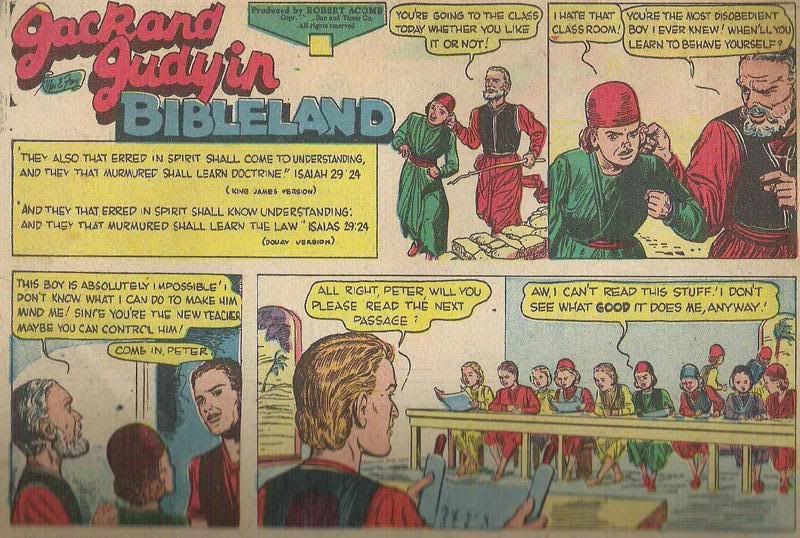
This uproariously anachronistic comic strip is an example of the didacticism kids were subjected to back in the 1950s. I found it on the reverse of a 1950 DICK TRACY Sunday in my comic-strip collection. (It's the 1.8.50 episode where Tracy runs off from the middle of his honeymoon to chase a crook. Bride Tess: "I should have known being married to Dick Tracy would be like this. I SHOULD HAVE KNOWN!" Can't disagree there.) The strip is about a pair of 20th-century kids plunked down in the land of the Bible to learn lessons in morality and obedience.

Now watch it go crazy in the second half!

Nice to know that teachers complained about one kid's "attitude" endangering the whole group 2000 years ago. (Yet another World War II legacy.) And note that Christianity comes down to obeying the ones in charge. All religions seem to tend in that direction, don't they?
BTW, wasn't Peter called Simon when he was younger? Every Sunday school teaches that!
Update: I finally figured out how to post the images right side up without cutting off any of the strip!
"Aren't you rather fond of him?" "I'm rather fond of rabbits, but they need to be kept down"--THE LADY VANISHES
Now watch it go crazy in the second half!

Nice to know that teachers complained about one kid's "attitude" endangering the whole group 2000 years ago. (Yet another World War II legacy.) And note that Christianity comes down to obeying the ones in charge. All religions seem to tend in that direction, don't they?
BTW, wasn't Peter called Simon when he was younger? Every Sunday school teaches that!
Update: I finally figured out how to post the images right side up without cutting off any of the strip!
"Aren't you rather fond of him?" "I'm rather fond of rabbits, but they need to be kept down"--THE LADY VANISHES
Sunday, February 03, 2008
Translation is everything
In THE TORONTO STAR today I was reading a review of Michael Dirda's CLASSICS FOR PLEASURE. Reviewer Michel Basilieres mentioned that he doesn't think much of Sappho's poems, and cited this translated poem that appeared in the book:
The moon has set
And the Pleiades. It is
Midnight. Time passes.
I sleep alone.
But I recall seeing a different translation some years back, which went like this:
The moon has sunk, and the Pleiades,
And midnight is gone.
And the hours are passing, passing...
And I lie alone.
Still think Sappho is overrated? That's the difference between a translation of a poem and a translation that's a poem itself.
Milhous: "My mom... says you're a bad influence on me." Bart Simpson: "Bad influence my butt! How many times have I told you not to listen to your mom?"
The moon has set
And the Pleiades. It is
Midnight. Time passes.
I sleep alone.
But I recall seeing a different translation some years back, which went like this:
The moon has sunk, and the Pleiades,
And midnight is gone.
And the hours are passing, passing...
And I lie alone.
Still think Sappho is overrated? That's the difference between a translation of a poem and a translation that's a poem itself.
Milhous: "My mom... says you're a bad influence on me." Bart Simpson: "Bad influence my butt! How many times have I told you not to listen to your mom?"
GIL THORP's Sunday companion
One of the odder comic strips I've been following on The Comics Curmudgeon is GIL THORP. It's a remarkably goofy daily strip about the eponymous high-school coach, who resembles the post-plastic surgery Mickey Rourke and teaches life lessons as well as athletics to various impressionable teenagers who go through bizarre adventures. The supporting cast includes Thorp's family; assistant coaches like Kaz, who once bodyguarded a Carole King-like singer over a summer tour and had to figure out who was sending her poison-pen letters, and Clambake, an aged Negro sage who told aspiring pitchers inspiring stories about training legends which turned out to be made up; Marty Moon, the snide, goateed sportscaster who often gets made a fool of and has drinking and gambling problems to deal with. And of course there's the kids, like the guy who saved someone's life but let another kid take the credit because he was enough of a hero already; the guy who lost a leg in a chainsaw accident; the new kid trying to live down his manslaughter trial that resulted from careless wrestling; the guy who bopped himself on the back of the head with a thick branch and said he'd been mugged. The current story involves Andrew Gregory, an attitude-challenged hotshot basketball shooter who nicknamed himself "the A-Train." All this is accompanied by some of the most bizarre visual compositions in the current comic-strip scene.
It may or may not interest some of the current fans to know that GIL THORP was once a better strip, as regards both writing and artwork. That was back when it was drawn by its original artist, Jack Berrill. (I actually read it for a while in my college days, when I started looking at a wide range of newspapers in the university library and often checked out the funnies pages.) All of this is an indirect way of answering the question two or three people must be wondering: Why isn't there a GIL THORP Sunday? The answer is that while it's always been dailies and nothing but, back in the late '60s through the mid-'70s Berrill actually drew a teenage Sunday strip for the same syndicate: TEEN-WISE! (That exclamation point was part of the title, which usually suggests a writer trying too hard. Another example is Upton Sinclair's OIL!, the book THERE WILL BE BLOOD is based on.)
Anyhow, TEEN-WISE! is a Sunday strip showing adolescents in challenging everyday situations, to teach them good sense. (Teen--wise, geddit?) It featured an annoying little owl giving the moral at the end. This was an old-fashioned concept for the time, and it's good for a few cynical laughs today.

Yeah, right. In the real world, of course, it's the well-informed teenagers who feel like misfits. (Take it from me.)
Gil Thorp himself had a cameo in a few episodes.

Another thing you could do is move to another school, get onto that school's team, play dirty against your old school and beat the pants off them. (Of course, if the new school's team takes you, chances are they aren't as good.) Or else you could avoid being a jock to begin with.
Happily, we get some multi-episode high school soap opera stories.

What do you think will be the outcome here?

But there are also dangerous situations. (Nice girls don't hitchhike!)

And there's the 13-year-old girl who lies about her age to get an 18-year-old boyfriend. (It helps to be tall.)

He fobbed her off on his friend Roman.
Somewhere in my immense comic-strip collection, on the reverse of some superior strip, I have a couple of TEEN-WISE episodes about The Marijuana Menace, in which a couple of users decide to retaliate against a girl who's threatening to squeal on them by giving her a beating. (Still think it's harmless?)
"I can allus tell a man who's married a good housekeeper from the way he brightens up when I speak kindly to him"
It may or may not interest some of the current fans to know that GIL THORP was once a better strip, as regards both writing and artwork. That was back when it was drawn by its original artist, Jack Berrill. (I actually read it for a while in my college days, when I started looking at a wide range of newspapers in the university library and often checked out the funnies pages.) All of this is an indirect way of answering the question two or three people must be wondering: Why isn't there a GIL THORP Sunday? The answer is that while it's always been dailies and nothing but, back in the late '60s through the mid-'70s Berrill actually drew a teenage Sunday strip for the same syndicate: TEEN-WISE! (That exclamation point was part of the title, which usually suggests a writer trying too hard. Another example is Upton Sinclair's OIL!, the book THERE WILL BE BLOOD is based on.)
Anyhow, TEEN-WISE! is a Sunday strip showing adolescents in challenging everyday situations, to teach them good sense. (Teen--wise, geddit?) It featured an annoying little owl giving the moral at the end. This was an old-fashioned concept for the time, and it's good for a few cynical laughs today.

Yeah, right. In the real world, of course, it's the well-informed teenagers who feel like misfits. (Take it from me.)
Gil Thorp himself had a cameo in a few episodes.

Another thing you could do is move to another school, get onto that school's team, play dirty against your old school and beat the pants off them. (Of course, if the new school's team takes you, chances are they aren't as good.) Or else you could avoid being a jock to begin with.
Happily, we get some multi-episode high school soap opera stories.

What do you think will be the outcome here?

But there are also dangerous situations. (Nice girls don't hitchhike!)

And there's the 13-year-old girl who lies about her age to get an 18-year-old boyfriend. (It helps to be tall.)

He fobbed her off on his friend Roman.
Somewhere in my immense comic-strip collection, on the reverse of some superior strip, I have a couple of TEEN-WISE episodes about The Marijuana Menace, in which a couple of users decide to retaliate against a girl who's threatening to squeal on them by giving her a beating. (Still think it's harmless?)
"I can allus tell a man who's married a good housekeeper from the way he brightens up when I speak kindly to him"
Subscribe to:
Posts (Atom)